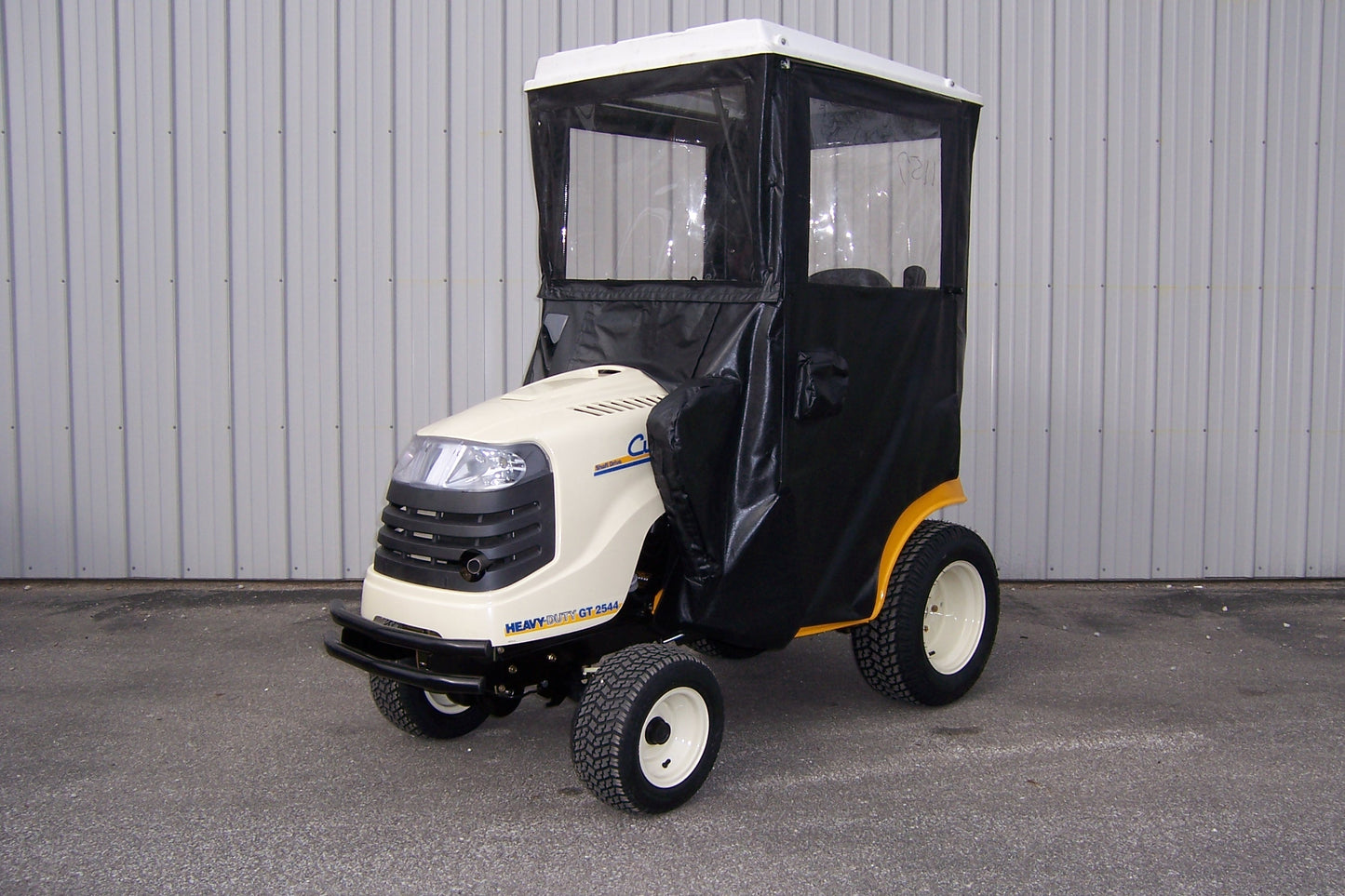
Cub Cadet 2000 & 2500 Series Hardtop Cab 11553
Keep using your Cub Cadet lawn or garden tractor when cold, rain, snow, sleet, and wind arrive. Original Tractor Cab Hardtop Cab 11553 is a model-fit weather enclosure for compatible Cub Cadet 2000 and 2500 Series tractors.
The cab surrounds much of the operator area with clear Lexan window material and heavy-duty stop-rip vinyl. Meanwhile, a molded ABS plastic hardtop gives the operator solid overhead weather coverage.
A 16-gauge steel tube frame supports the enclosure. In addition, hinged doors make it easy to enter and leave the operator area.
Best of all, normal installation requires no holes to be drilled in the tractor. Cab 11553 gives owners of these older Cub Cadet machines a direct way to add useful weather protection without replacing a tractor that still works well.
Original Tractor Cab 11553 for Cub Cadet 2000 & 2500 Series Tractors
Cub Cadet built the 2000 and 2500 Series for mowing and property work. Many of these tractors remain in service today.
However, an open operator station puts the driver in the weather. So, Cab 11553 adds an enclosure that helps make cold-season work more comfortable.
The design is made for specific Cub Cadet tractor series rather than being a loose universal cover.
Model-Fit Cab Design
A model-fit cab can provide a cleaner installation than a one-size-fits-all enclosure. Therefore, Original Tractor Cab designed the 11553 around compatible Cub Cadet 2000 and 2500 Series lawn and garden tractors.
The frame, roof, doors, and enclosure work together around the operator area. Still, these tractors are now older machines and may have been changed over time.
Confirm the exact tractor before ordering.
Molded ABS Plastic Hardtop
Cab 11553 uses a molded ABS plastic hardtop. The current roof is black and contains a UV inhibitor for added durability and appearance.
The hard roof keeps its shape and provides solid overhead coverage. Therefore, it can help block falling rain, snow, sleet, and direct overhead sun.
The roof is part of the weather enclosure, not a safety structure.
Hard Roof for Winter Work
Winter chores often place the operator outside when the weather is at its worst. A hard roof helps keep falling snow and sleet away from the top of the operator area.
Meanwhile, the rest of the enclosure helps reduce wind and blowing snow from other directions. As a result, Cab 11553 offers more weather coverage than a simple overhead canopy.
It does not create a sealed compartment.
Clear Shatter-Resistant Lexan Window Material
Good sight is vital on a tractor. Therefore, Original Tractor Cab uses clear, shatter-resistant Lexan window material in Cab 11553.
The window material stays flexible in sub-zero temperatures. It is also made to resist puckering, which helps preserve a useful view around the operator.
Keep each viewing area clean before use.
Clear View During Snow Removal
Snow can build up on a cab during winter work. So, stop and clean the clear panels whenever your view becomes poor.
Never keep driving just because the tractor can still move. Good visibility is more important than finishing a snow job quickly.
Slow down when snow or ice reduces sight.
Heavy-Duty Stop-Rip Vinyl Cab Shell
Heavy-duty stop-rip vinyl makes up much of the flexible shell on Cab 11553. The material gives the enclosure useful strength without the weight of a full steel cab.
Original Tractor Cab states that the fabric resists abrasion, water, fire, mildew, and rot. Therefore, the material is well suited to normal outdoor equipment use.
Inspect the vinyl often for wear or damage.
Flexible Enclosure for Seasonal Use
A flexible shell helps keep the cab practical for a lawn and garden tractor. In addition, the enclosure can be removed when the season changes.
This gives owners the option to use weather coverage in winter and return to a more open tractor later.
Store removed cab material clean and dry.
16-Gauge Steel Tube Cab Frame
Cab 11553 uses a 16-gauge steel tube frame. The frame supports the hardtop, doors, windows, and flexible enclosure around the operator.
Steel provides a firm base for the weather cab. However, this structure is not a rollover cage or falling-object guard.
Its job is to support the enclosure.
Weather Frame, Not a Rollover Structure
A steel cab frame can look strong. Yet appearance does not make it certified rollover protection.
Therefore, never use Cab 11553 as a substitute for factory safety equipment. Likewise, do not rely on it to stop a tree limb, thrown object, or collision.
The cab provides weather protection only.
Hinged Cab Doors
Hinged doors make it easier to enter and exit Cab 11553. They also help close the sides of the operator area during cold-weather work.
Before starting the tractor, open and close each door. Then, make sure the doors latch correctly and stay clear of all controls.
Never operate with a damaged door mount.
Check Door Clearance
Older tractors may have owner-added accessories near the operator area. Therefore, make sure nothing blocks the door path.
A door should open and close without striking a control, attachment, or other tractor part. Also, the operator must be able to exit the cab without a problem.
Correct any issue before use.
Forward-Sloped Windshield Design
Original Tractor Cab gives the front windshield a forward inclination. This design helps reduce glare and contact with falling rain and snow.
The angle also helps create room around the operator area. Still, snow and ice can collect on the clear material.
Clean the windshield whenever the view becomes poor.
Reduce Glare While You Work
Winter sun can reflect strongly from fresh snow. Therefore, glare can become a real concern even on a cold day.
The forward windshield angle helps reduce some reflected glare. However, it cannot remove every bright reflection.
Use safe eye protection when conditions call for it.
No Holes to Drill
Original Tractor Cab states that Cab 11553 requires no holes to be drilled during normal installation on the correct tractor.
That helps preserve the tractor and makes the installation more direct. Instead, the cab uses its model-fit mounting system.
Follow the illustrated instructions closely.
Do Not Modify the Tractor to Force Fit
A used Cub Cadet may no longer match its original factory setup. Seats, fenders, controls, or other parts may have changed.
Therefore, stop if the cab does not align with the mounting points shown in the instructions. Never cut or drill safety-related tractor parts simply to make the enclosure fit.
Confirm the application first.
Approximate Two-to-Four-Hour Assembly Time
Original Tractor Cab lists an approximate assembly time of two to four hours for Cab 11553.
Actual time can change with experience, tractor condition, and available tools. So, allow enough time to complete the work without rushing.
Read the instructions before starting.
Check Every Control After Installation
A correct cab installation must leave every tractor control free to move. Therefore, sit in the normal operating position after assembly.
Test the steering wheel, pedals, PTO control, throttle, brake, deck controls, and other equipment. Nothing from the cab should block normal operation.
Fix any interference before starting the engine.
Simple Seasonal Removal and Reassembly
Cab 11553 can be removed when the weather warms. Original Tractor Cab designed the enclosure so seasonal removal and reassembly remain practical.
That is useful for owners who want an enclosed tractor in winter but prefer an open operator station during summer mowing.
Keep all removed hardware together.
Store the Cab Properly
Clean the enclosure before storage. Then, let the vinyl and clear panels dry fully.
Moisture trapped during storage can lead to unwanted dirt or mildew. Likewise, sharp folds can damage clear flexible window material.
Store the parts in a clean, dry place.
Remove Vinyl Panels Before Open-Trailer Transport
Original Tractor Cab gives an important transport warning for Cab 11553. Remove the vinyl panels before carrying the tractor in an open truck or on an open trailer.
High road-speed airflow creates forces far beyond normal tractor operation. Therefore, do not tow the tractor at highway speed with the flexible cab shell in place.
Follow the installation manual before transport.
Road Wind Is Not Normal Tractor Wind
A cab may handle normal wind during yard work. However, open-trailer transport can expose the material to continuous high-speed airflow.
That can damage the vinyl, windows, frame, or mounts. So, remove the required panels before transport.
Secure all removed parts separately.
Cab 11553 Helps Block Snow
Snow removal is one of the strongest reasons to add a cab to a garden tractor. Without an enclosure, wind can blow loose snow back toward the operator.
Cab 11553 helps place a barrier between the driver and that weather. Therefore, winter chores can feel less exposed.
Keep the clear panels free of snow.
Useful With Compatible Snow Equipment
Many Cub Cadet garden tractors were built to handle more than mowing. Compatible machines may use snow blades, snow throwers, or other seasonal equipment.
However, attachment fit is separate from cab fit. Therefore, confirm that the cab and attachment can work together before use.
Never assume accessory compatibility.
Cab 11553 Helps Block Rain
The molded hardtop and enclosure help reduce direct rain around much of the operator area.
However, Cab 11553 is not a sealed waterproof compartment. Wind-driven rain may still enter through normal gaps and openings.
Stop work during dangerous storms.
Cab 11553 Helps With Sleet and Wind
Sleet and cold wind can make winter chores much harder. So, the enclosure helps reduce direct contact with both.
Still, the cab does not contain a heater and is not airtight. Dress for the temperature even when the cab is installed.
Operator comfort still starts with proper clothing.
Cab 11553 Is Not Certified Hail Protection
The hardtop gives useful overhead weather coverage. However, it is not a certified hail or falling-object protective structure.
Therefore, seek safe shelter during severe storms. Never stay outdoors during dangerous hail or lightning simply because the tractor has a cab.
Weather coverage does not remove storm risk.
Keep the Cab Away From Hot Tractor Parts
Gasoline engines and exhaust systems can become very hot. Therefore, no vinyl, clear panel, or other cab material should touch the muffler or engine exhaust.
Inspect the installation before each season. Also, recheck the cab after major tractor service.
Stop use if any material moves toward a hot part.
Never Run the Tractor in an Enclosed Building
Cab 11553 does not control engine exhaust. So, never run a gasoline-powered tractor inside a closed garage, shed, or other enclosed building.
Carbon monoxide can build up and can cause death. Move the tractor outdoors before running the engine as directed by the tractor maker.
Keep exhaust away from doors and windows.
Made in the USA
Original Tractor Cab states that Cab 11553 is made in the USA. The product continues a manufacturing tradition that began in 1939.
Today, Original Tractor Cab makes weather enclosures and sunshades for many types of outdoor equipment.
Cab 11553 carries that experience to older Cub Cadet owners.
Buy Cub Cadet Cab 11553 Direct From Original Tractor Cab
Many owners first found Original Tractor Cab products through equipment dealers. Today, you can also buy direct from the company that makes the cab.
For more model-fit products, browse the Original Tractor Cab Cub Cadet collection.
You can also compare other enclosures in our tractor cab collection.
Before assembly, use our installation manual library to review current installation information.
If you are unsure about an older tractor, use the Original Tractor Cab contact page for fit help.
Cub Cadet 2000 & 2500 Series Tractor Specifications
Cab 11553 covers two broad Cub Cadet lawn and garden tractor families. Therefore, one engine, deck size, transmission, or weight does not describe every compatible tractor.
The 2000 Series included many models over the years. Likewise, the 2500 Series included several garden tractors with different engine and mower configurations.
Use your full tractor model and serial number for exact specifications.
Cub Cadet 2000 Series
The Cub Cadet 2000 Series included lawn and garden tractors made for mowing and property work.
Examples from the older Series 2000 family include the 2130, 2135, 2140, 2145, 2160, 2165, 2185, 2164, 2166, 2176, 2186, and 2206.
Exact Cab 11553 fit should be confirmed before ordering.
2000 Series Engine Power
Engine power changed greatly across the 2000 Series. Early models included machines near 12.5 horsepower, while later tractors reached about 20 horsepower.
For example, the 2166 was rated at about 16 horsepower. Meanwhile, the 2186 was rated near 18 horsepower and the 2206 near 20 horsepower.
Engine make and displacement also varied.
Kohler and Other Engines in the 2000 Series
Cub Cadet used several engines during the long life of the 2000 Series. Kohler engines appeared in many models.
Some earlier machines also used other engine configurations. Therefore, do not buy filters, plugs, belts, or engine parts from the Series 2000 name alone.
Use the engine identification label.
Gasoline Engine Design
These garden tractors use gasoline engines. Many later models use air-cooled designs that depend on clean cooling fins and proper airflow.
Therefore, keep grass and debris away from engine cooling areas. Cab material must also stay clear of the engine and exhaust.
Follow the tractor service schedule.
2000 Series Mower Deck Sizes
Deck sizes also changed across the 2000 Series. Depending on model, published configurations include decks around 38, 42, 44, 46, and 48 inches.
For example, the 2166 commonly used a 42-inch deck. The 2186 used a 44-inch deck, while the 2206 was associated with a 48-inch deck.
Deck fit varies by tractor.
Deck Width Does Not Confirm Cab Fit
Two tractors can use similar mower decks while having different frames or operator areas.
Therefore, never use deck width alone to decide whether Cab 11553 fits. The tractor model remains the more important detail.
Check the installation guide before ordering.
Hydrostatic and Other 2000 Series Drives
Transmission design also changed through the 2000 Series. Some early machines used a six-speed drive, while others used hydrostatic drive.
Hydrostatic models let the operator change travel speed without shifting through a normal set of forward gears. As a result, they can be convenient for mowing and snow work.
Always identify the exact tractor.
2000 Series Tractor Dimensions
Dimensions vary by model. However, several older Series 2000 tractors use a wheelbase close to 47 inches.
For example, factory service data for selected early machines lists an overall length near 72 inches and steering-wheel height near 42 inches.
Mower decks and attachments change total width and length.
Cub Cadet 2500 Series Garden Tractors
The Cub Cadet 2500 Series moved further into heavy garden tractor work. Models included the 2518, GT 2521, GT 2523, GT 2542, GT 2544, GT 2550, and GT 2554.
These tractors offered different horsepower and deck combinations. Therefore, the series name should be treated as a family rather than one exact machine.
Confirm Cab 11553 fit for your tractor.
Cub Cadet 2518
The Cub Cadet 2518 was part of the early 2500 Series. Published specifications rate it at about 20 horsepower.
Mower options included 44 and 48-inch configurations. As a result, the tractor could handle a wider mowing path than many smaller lawn tractors of its era.
Exact equipment depends on the tractor.
Cub Cadet GT 2521
The GT 2521 was a 2500 Series garden tractor rated at about 21 horsepower. Published information associates it with a 48-inch mower deck.
That gave the tractor useful mowing capacity for larger properties. However, deck width does not identify every attachment or cab detail.
Use the full model number.
Cub Cadet GT 2523
The GT 2523 increased published engine output to about 23 horsepower. It was associated with a 54-inch mower deck.
Therefore, the tractor could cover a broad mowing path on open ground. A wider deck also requires more care around gates, trees, and buildings.
Know the complete machine width.
Cub Cadet GT 2542
The GT 2542 was produced during the later 2500 Series era. Published specifications list a 20-horsepower Kohler V-twin engine and a 42-inch mower deck.
The Kohler engine has about 624 cc of displacement. In addition, the tractor uses electric starting.
Exact specifications can change by production year.
GT 2542 Kohler V-Twin Engine
A V-twin engine can provide smooth power for mowing and property work. The GT 2542's published Kohler engine rating is about 20 horsepower.
However, service parts must match the exact engine model. Therefore, record the engine number before ordering maintenance parts.
Never order by horsepower alone.
Cub Cadet GT 2544
The GT 2544 was offered with a 44-inch mower deck. Engine specifications changed during its production life.
Published records show Kohler V-twin engines from about 20 to 22 horsepower, depending on year. Displacement was about 624 cc on earlier versions and about 671 cc on selected later versions.
That variation makes the model year important.
GT 2544 Hydrostatic Transmission
The GT 2544 uses hydrostatic drive. Therefore, the operator can control travel speed without shifting through a normal manual transmission.
The tractor uses two-wheel drive and an open operator station in its standard form.
Cab 11553 adds weather coverage around that station.
Cub Cadet GT 2550
The GT 2550 is a 2500 Series garden tractor with a 50-inch mower deck. Published specifications rate its Kohler V-twin gasoline engine at about 22 horsepower.
The engine has about 624 cc of displacement. Meanwhile, published fuel capacity is about 2.25 gallons.
The tractor uses hydrostatic drive.
GT 2550 Size and Weight
Published GT 2550 data lists a 47-inch wheelbase. Tractor weight is about 841 pounds before considering every possible attachment.
Front tires are commonly listed as 16x6.5-8. Rear tires are commonly listed as 23x9.5-12.
Actual equipped weight can be higher.
Cub Cadet GT 2554
The GT 2554 sits near the upper end of this 2500 Series group. Published specifications rate its Kohler V-twin gasoline engine at about 23 horsepower.
The engine has about 624 cc of displacement. In addition, the tractor was offered with a 54-inch mower deck.
The larger deck suits broad mowing areas.
GT 2554 Hydrostatic Drive
The GT 2554 uses a hydrostatic transmission. It also uses two-wheel drive and an independent front PTO with an electric clutch.
That PTO system drives compatible front equipment such as the mower deck. However, attachment requirements can vary.
Follow the tractor and attachment manuals.
GT 2554 Dimensions and Weight
Published GT 2554 specifications list a 47-inch wheelbase. Tractor weight is about 846 pounds in standard published form.
Common tire sizes include 16x6.5-8 at the front and 23x9.5-12 at the rear. However, replacement tires may differ on an older tractor.
Inspect the actual machine.
2500 Series Mower Deck Range
The 2500 Series covered several mower sizes. Published models include 42, 44, 48, 50, and 54-inch deck configurations.
Therefore, the series served properties with different mowing needs. A larger deck covers more ground, while a smaller deck may fit tighter spaces.
Choose parts by exact model.
Front PTO and Electric Clutch
Several later 2500 Series tractors use an independent front PTO with an electric clutch.
This system lets the operator engage compatible powered equipment from the tractor. However, the PTO and attachment contain moving parts that can cause serious injury.
Keep every factory shield in place.
Stop the Engine Before Attachment Service
Never reach under a mower deck or into snow equipment while parts can move. Therefore, shut down the tractor and follow the factory service procedure.
Remove the key and wait for all moving parts to stop. Also, support raised equipment correctly before working beneath it.
Cab 11553 does not protect from attachment hazards.
Two-Wheel Drive Garden Tractor Design
Many tractors in these Cub Cadet series use two-wheel drive. That design works well for normal mowing and many property jobs.
However, snow and ice can reduce traction. Therefore, compatible tire chains or approved ballast may help on some winter setups.
Use only equipment approved for the tractor.
Winter Traction and Cab Clearance
Tire chains can extend beyond the normal tire surface. So, check chain clearance from the cab mounts and other tractor parts.
Turn and move the tractor slowly while checking the installation. Stop if a chain can contact the cab or another component.
Never operate with known interference.
Manual Steering on Many Models
Many tractors in these series use manual steering. Therefore, steering effort can change with tire condition, attachment weight, and ground surface.
Snow equipment or front-mounted accessories can also change the steering feel. So, reduce speed until you understand how the equipped tractor handles.
Keep both hands ready to steer.
Garden Tractor Attachment Capability
Cub Cadet garden tractors can do more than cut grass. Depending on model, they may work with snow blades, snow throwers, carts, baggers, and other attachments.
That makes Cab 11553 especially useful for owners who use the tractor after mowing season ends.
Still, every attachment must be checked for cab compatibility.
Snow Thrower Work
A front snow thrower can send loose snow high into the air. Wind may then push part of that snow back toward the tractor.
Cab 11553 helps reduce direct exposure around the operator. However, the cab is not a debris shield.
Aim the discharge away from people and property.
Use the Tractor Model and Serial Number
The 2000 and 2500 Series cover many years and many tractor configurations. Therefore, model identification is important.
Record the complete model and serial number before ordering service parts, attachments, or a cab. Also, note any major changes made by a previous owner.
Good identification helps prevent fit mistakes.
Older Tractors May Have Changed
A tractor that has worked for twenty years may not be exactly as it left the factory. Seats, engines, tires, controls, and body parts can be replaced.
As a result, the actual tractor should always be inspected before installing Cab 11553.
Contact Original Tractor Cab when fit is uncertain.
Official Cub Cadet Information
Exact specifications can vary by model, serial number, and production year. Therefore, use factory information when you need service or operating data.
For current manufacturer support, visit the official Cub Cadet website.
For older equipment information, use the official Cub Cadet prior-year model resource.
The History of Original Tractor Cab Company
Original Tractor Cab began in 1939. At that time, farmer Stanley Williams needed better protection from harsh weather while working on his tractor.
So, Stanley designed a cab for his own machine. Other farmers soon saw the value of the idea.
That practical farm solution became the start of a company.
Born From a Real Need on the Farm
Farm work could not always wait for a warm and dry day. Rain, snow, cold, wind, and sun were normal parts of life.
Therefore, Stanley's cab solved a real problem. It helped place a barrier between the tractor operator and bad weather.
Other farmers wanted the same kind of help.
A Small Farm Idea Starts to Grow
Word spread about Stanley's cab. Then, he placed a small advertisement in a farm magazine.
The response showed that operators in other areas had the same need. As a result, a product built for one farmer became the base of a growing business.
Original Tractor Cab traces its start to 1939.
American Manufacturing From the Start
The company grew around a simple idea: make practical products for people who work outdoors.
That idea remained useful as tractors and outdoor equipment changed. Therefore, Original Tractor Cab continued to adapt its designs to new machines.
The work stayed rooted in American manufacturing.
Original Tractor Cab During World War II
World War II changed the direction of the young business. Normal tractor cab production stopped as the company turned its manufacturing skills toward the war effort.
Original Tractor Cab made backpacks and other needed military items. Afterward, the company returned its attention to products for outdoor equipment.
That ability to adapt became part of its history.
Outdoor Equipment Changes After the War
Tractors became more advanced after World War II. At the same time, lawn and garden equipment became more common around homes and larger properties.
So, Original Tractor Cab expanded its product ideas beyond traditional farm tractors.
New equipment created new weather-protection needs.
The Next Generation Adds Snowblower Cabs
Stanley's son Robert Williams saw another weather problem. Walk-behind snowblower operators often worked directly in cold wind and blowing snow.
Therefore, Robert developed and patented a snowblower cab. That idea moved Original Tractor Cab into another important outdoor equipment market.
Lawn and garden products followed.
Cabs for Lawn and Garden Tractors
Lawn and garden tractors became stronger and more useful. Owners began using them for mowing, hauling, and winter snow removal.
As a result, cab enclosures became useful on smaller machines too. Original Tractor Cab developed products for many of these tractors.
Cab 11553 is part of that product history.
The Third Generation Adds Sunshades
Winter weather was not the only problem for equipment operators. Hot summer sun could also make long hours outdoors uncomfortable.
Therefore, Stanley's grandson Wayne Williams developed and patented a sunshade in the early 1990s.
The company could now help operators in more seasons.
Three Generations of the Williams Family
Three generations of the Williams family helped carry Original Tractor Cab forward.
Each generation added products as equipment changed. However, the core idea stayed much the same.
Build useful weather products for people who work outside.
From Farm Tractors to Cub Cadet Garden Tractors
The Cub Cadet 2000 and 2500 Series are much different from the farm tractor Stanley used in 1939.
Yet the person in the seat still faces rain, snow, sleet, wind, cold, and sun. Therefore, the need for weather protection remains easy to understand.
Cab 11553 brings that idea to these Cub Cadet tractors.
Made in the USA Since 1939
Original Tractor Cab remains an American manufacturer. Today, its products include hardtop cabs, soft enclosures, snowblower cabs, tractor sunshades, mower sunshades, and accessories.
The company is based in Arlington, Indiana. Meanwhile, its history now spans more than eight decades.
Cab 11553 continues that long product tradition.
Learn more on the Original Tractor Cab company history page.
Cub Cadet 2000 & 2500 Series Cab 11553 Frequently Asked Questions
What tractors fit Original Tractor Cab 11553?
Cab 11553 is designed for compatible Cub Cadet 2000 and 2500 Series lawn and garden tractors. Because these series include many models and years, confirm your exact tractor before ordering.
Is Cab 11553 a hardtop cab?
Yes. Cab 11553 uses a molded ABS plastic hardtop with a UV inhibitor. Current hardtops are black.
What is the cab frame made from?
Original Tractor Cab uses 16-gauge steel tube construction to support the enclosure.
What are the cab windows made from?
Cab 11553 uses clear, shatter-resistant Lexan window material that remains flexible in sub-zero temperatures.
What is the flexible enclosure made from?
The cab uses heavy-duty stop-rip vinyl fabric. Original Tractor Cab states that the material resists abrasion, water, fire, mildew, and rot.
Does Cab 11553 have hinged doors?
Yes. Cab 11553 uses hinged doors for access to the operator station.
Does Cab 11553 require drilling?
Original Tractor Cab states that no holes need to be drilled during normal installation on the correct tractor.
How long does Cab 11553 take to assemble?
Original Tractor Cab lists an approximate assembly time of two to four hours. Actual time can vary with experience and tractor condition.
Can Cab 11553 be removed after winter?
Yes. Original Tractor Cab designed the cab for seasonal removal and reassembly.
Can I transport the tractor on an open trailer with the vinyl cab installed?
Original Tractor Cab instructs owners to remove the vinyl panels before transporting the tractor in an open truck or trailer.
Does Cab 11553 help protect from snow?
Yes. The hardtop and enclosure help reduce direct exposure to normal falling and blowing snow.
Does Cab 11553 help protect from rain and sleet?
Yes. The enclosure helps reduce direct exposure to normal rain and sleet. However, it is not a sealed waterproof compartment.
Does Cab 11553 help block wind?
Yes. The enclosure can reduce direct wind around the operator. Still, the cab is not airtight or heated.
Does Cab 11553 protect from hail?
No. Cab 11553 is not certified hail or falling-object protection.
Does Cab 11553 provide rollover protection?
No. The cab is a weather enclosure. Its frame and roof are not certified rollover protective structures.
Does the cab protect from mower or snowblower debris?
No. Cab 11553 is not a certified impact or debris shield. Keep factory guards in place and follow all attachment safety rules.
What engines did Cub Cadet 2500 Series tractors use?
Engine specifications vary by model and year. Later GT 2542, GT 2544, GT 2550, and GT 2554 tractors commonly used Kohler V-twin gasoline engines rated from about 20 to 23 horsepower.
What mower deck sizes were used on the 2500 Series?
Published 2500 Series configurations include 42, 44, 48, 50, and 54-inch mower decks, depending on tractor model.
Is Cab 11553 a genuine Cub Cadet OEM cab?
No. Cab 11553 is an aftermarket product manufactured by Original Tractor Cab Co., Inc. for compatible Cub Cadet tractors.
Non-OEM and Liability Disclaimer
This is an aftermarket product produced by the Original Tractor Cab Co. Inc., it is not a genuine OEM item. This product will only protect from elements not rollover or debris.
Original Tractor Cab Co., Inc. is not affiliated with, sponsored by, or endorsed by Cub Cadet or MTD Products. Cub Cadet, related trademarks, logos, series names, and model names remain the property of their respective owners. Brand and model references are used only to identify intended product compatibility.
Cab 11553 is intended for compatible Cub Cadet 2000 and 2500 Series lawn and garden tractors. These product families contain many models and production years. Therefore, owners must confirm the exact model, serial number, controls, seat, frame, attachments, and current tractor configuration before purchase and installation.
Many Cub Cadet 2000 and 2500 Series tractors have now been in service for many years. Previous owners may have replaced seats, engines, tires, controls, fenders, or other components. Any change can affect cab fit.
Cab 11553 is designed to help reduce direct exposure to normal rain, snow, sleet, wind, and cold. It does not create a sealed, heated, waterproof, impact-resistant, or certified protective operator compartment.
The 16-gauge steel frame, molded ABS roof, clear Lexan material, doors, and vinyl enclosure do not provide certified rollover, falling-object, collision, hail, or debris protection.
Always follow the Cub Cadet operator manual and current Original Tractor Cab installation instructions. Keep all factory guards, shields, interlocks, warning labels, brakes, PTO shields, and other safety devices in place and working.
Never drill, cut, bend, weld, remove, or weaken safety-related tractor components to force the cab to fit. Stop installation if the tractor does not match the instructions.
Check steering, pedals, brakes, PTO controls, throttle, deck controls, doors, operator movement, visibility, cooling airflow, and attachment movement before use. Stop using the tractor if any cab component interferes with normal operation.
Attachments change tractor dimensions, weight, traction, and handling. Therefore, always follow the correct Cub Cadet instructions for mower decks, snow throwers, blades, carts, baggers, ballast, tire chains, and other equipment.
Remove the vinyl cab panels before transporting the tractor in an open truck or on an open trailer as directed by Original Tractor Cab.
California Proposition 65 Warning
WARNING: Cancer and Reproductive Harm — www.P65Warnings.ca.gov.
This product and the tractor on which it is installed may expose users to chemicals known to the State of California to cause cancer, birth defects, or other reproductive harm. Possible sources may include gasoline engine exhaust, fuel, oils, batteries, plastics, vinyl, metals, electrical parts, and other tractor or cab materials. Follow all product and equipment safety instructions. Operate gasoline-powered equipment outdoors with proper ventilation, wash hands after handling applicable materials, and avoid unnecessary exposure.