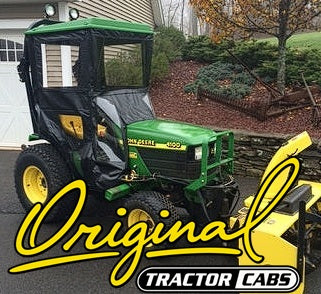
John Deere 4100 & 4110 Compact Hardtop Cab 11023
Keep using your John Deere 4100 or 4110 when cold and wet weather moves in. Original Tractor Cab 11023 is a model-fit hardtop cab enclosure for these compact utility tractors. So, you can add useful protection from rain, snow, sleet, and cold wind without replacing a tractor that still works hard.
A molded ABS plastic roof gives the operator firm overhead cover. Meanwhile, clear shatter-resistant Lexan panels help keep a wide view around the tractor. Hinged doors make entry simple, while a model-fit steel frame supports the enclosure.
Installation takes about three to four hours for a typical first install. In addition, normal installation does not require drilling because the cab mounts use existing tractor holes.
Cab 11023 fits the John Deere 4100 and 4110. However, it does not fit the John Deere 4115. Therefore, check the tractor model before you order.
Hardtop Cab for John Deere 4100 and 4110 Compact Tractors
The John Deere 4100 and 4110 are small compact tractors with many uses. Owners can mow, move material, haul, grade, and clear snow with the right equipment. Yet an open operator station leaves the driver exposed to bad weather.
Rain can soak clothing fast. Likewise, cold wind can reach the operator from every side. Snow may also blow back toward the seat during winter work.
Cab 11023 adds a weather barrier around much of the operator station. As a result, less direct rain, snow, sleet, and wind can reach the driver.
Molded ABS Plastic Hardtop
Cab 11023 uses a molded ABS plastic roof. So, the operator gets a firm hardtop instead of a fabric roof.
The ABS top gives useful overhead weather cover. Therefore, falling rain, snow, and sleet meet the roof before they reach the operator.
The hardtop is made for weather protection only. It is not a Falling Object Protective Structure or impact guard.
Clear Lexan Windshield
Good visibility matters on a compact tractor. For that reason, Cab 11023 uses clear shatter-resistant Lexan plastic for the windshield.
The large clear front area helps you watch the path ahead. Likewise, it helps you see a loader, blade, snow equipment, vehicle, building, tree, or other object near the tractor.
Lexan is tough, but it can still scratch. Therefore, use proper cleaning methods and never rub dry dirt across the clear surface.
Forward-Sloped Windshield Design
The Cab 11023 windshield slopes forward. This simple design serves more than one purpose.
First, the angle helps reduce glare. In addition, the forward slope can reduce contact with falling rain and snow.
A clear view is still the operator's job. So, stop the tractor when frost, snow, dirt, or moisture keeps you from seeing the work area.
Clear Lexan Side Doors
Side visibility is important during loader and snow work. Therefore, Cab 11023 uses clear shatter-resistant Lexan plastic in the door areas.
The large clear sections help keep the sides of the tractor in view. Meanwhile, the doors create a useful barrier against direct wind and blowing snow.
Clear doors do not protect against flying objects. Never rely on them to stop a branch, rock, ice, loader material, or other debris.
Clear Rear Curtain
Weather can reach an operator from behind. So, Cab 11023 also uses clear Lexan plastic in the rear curtain.
The rear enclosure helps block direct wind and swirling snow around the seat. At the same time, the clear material helps maintain rear visibility.
Always turn and check the full area before backing. The rear curtain does not replace safe tractor operation.
Hinged Doors With Latches
Cab 11023 has hinged doors with latches. Thus, you can enter and leave the cab without removing a loose side panel.
The latch system also helps keep each door in its normal position during use. Therefore, inspect door hardware from time to time.
Never operate the tractor if a loose door or cab part blocks a control, exit, or field of view.
No Drilling for Normal Installation
Original Tractor Cab designed Cab 11023 around existing tractor mounting points. As a result, normal installation does not require holes to be drilled in the tractor.
That model-fit design helps preserve the machine. Likewise, it reduces the need for permanent changes during cab installation.
Always use the correct brackets and hardware. Never drill or alter a factory safety structure to make the cab fit.
Three to Four Hour Installation Time
Original Tractor Cab lists a normal installation time of about three to four hours. First-time installation may vary with tools, experience, and tractor condition.
Read the full instructions before you begin. Then, lay out all parts and hardware before assembly.
A careful first installation can also make later seasonal removal and installation easier.
83-Inch Installed Cab Height
Original Tractor Cab lists Cab 11023 at about 83 inches high after installation. That added height matters around garages, sheds, trailers, and trees.
A low object that once cleared the tractor may now strike the cab. Therefore, measure the complete machine after installation.
Leave added space above the measured height. Ground slope, tires, tire pressure, and machine movement can change real clearance.
Rain Protection for John Deere 4100 and 4110
Cold rain can make outdoor tractor work hard. Water may reach the operator from above, in front, and from the sides.
Cab 11023 places an ABS hardtop and clear enclosure around much of the operator station. Therefore, it helps reduce direct contact with normal rain.
The cab is not watertight. Still, it provides far more weather cover than an open tractor station.
Snow Protection for Winter Tractor Work
The John Deere 4100 and 4110 can remain useful when winter arrives. Owners may use compatible front or rear equipment to move snow.
However, wind can send loose snow back toward the tractor. Cab 11023 helps block much of that direct snow. In addition, its side and rear panels help reduce swirling snow around the operator.
Snow can still reduce traction and visibility. So, slow down and use the ballast and traction equipment required for your tractor and attachment.
Sleet and Cold Wind Protection
Sleet can strike exposed skin and clothing. Cold wind can also make a winter job feel far worse.
Cab 11023 creates a barrier around much of the operator area. As a result, direct sleet and wind have less contact with the driver.
The cab does not include heat or insulation. Therefore, always dress for the actual outside temperature.
Optional Safety Glass Windshield
Original Tractor Cab offers an optional safety glass windshield for Cab 11023. So, owners can replace the standard Lexan windshield with a compatible glass option.
The glass windshield also matters if you want an electric wiper. Original Tractor Cab requires the safety glass windshield for electric wiper use.
Confirm current accessory fit before ordering. Product options can change over time.
Optional Electric Windshield Wiper
An electric windshield wiper is available as an optional Cab 11023 accessory. However, it must be used with the optional safety glass windshield.
A wiper can help during wet snow or rain. Still, it cannot guarantee a clear view in every condition.
Stop the tractor if the windshield becomes too covered to see safely.
No Manual Wiper for Cab 11023
Original Tractor Cab states that no manual wiper is available for this cab. Therefore, owners who want a wiper should use the approved electric system with the required safety glass windshield.
Do not install an unapproved wiper on the standard Lexan windshield. The wrong system may scratch or damage the clear material.
Always follow the current accessory instructions during installation.
Optional Caution Light
Original Tractor Cab also lists a caution light as an available accessory for Cab 11023. A warning light may help make the tractor easier to see in some work areas.
A caution light does not replace normal lighting or safe operation. Therefore, use the tractor lights and warning equipment required for the job.
Check local rules before operating near a public road.
Optional Work Lights
Winter days can get dark early. So, optional work lights may be useful for owners who work before sunrise or after sunset.
Added lighting can help illuminate the work area. However, lights must never create glare that blocks the operator's view.
Route all wiring safely and keep it away from hot, sharp, or moving tractor parts.
Optional Mirror
A mirror is another Cab 11023 accessory listed by Original Tractor Cab. It can help the operator check part of the area around the tractor.
A mirror does not show every blind spot. Therefore, turn and look before backing or changing direction.
Keep the mirror clean and adjust it before starting work.
Browse Cab Accessories
Accessory needs vary from one owner to another. Some users may want a glass windshield and wiper, while others may need lights or a mirror.
Browse Original Tractor Cab accessories for current cab options and replacement products.
Always confirm that an accessory fits Cab 11023 before ordering.
Cab 11023 for Tractors With a Folding Roll Bar
Some John Deere 4100 and 4110 tractors use a folding roll bar. Original Tractor Cab publishes supplemental Cab 11023 instructions for these machines.
The supplemental setup changes part of the rear cab mounting method. Therefore, owners of tractors with a folding roll bar should follow those instructions rather than the standard rear mounting steps.
Never guess at ROPS mounting. Use only the correct Original Tractor Cab hardware and instructions.
Special Folding ROPS Hardware
The supplemental instructions use roll bar clamps, U-clamps, spacers, bolts, and nuts to connect the rear portion of the cab frame.
For a folding roll bar application, the standard roll bar bracket identified in the main instructions is not used in that mounting step. Instead, the supplemental hardware creates the required connection.
Follow the current manual exactly. Never substitute hardware unless Original Tractor Cab approves the change.
Cab 11023 Does Not Replace the ROPS
The tractor's rollover structure is a safety system. Cab 11023 is only a weather enclosure.
Therefore, never cut, drill, weld, bend, remove, or weaken the ROPS to install the cab. Use the seat belt and ROPS as John Deere directs.
The ABS roof, Lexan windows, doors, and cab frame do not provide rollover protection.
Foul-Weather Protection Only
Cab 11023 helps protect against normal weather. It does not turn the John Deere 4100 or 4110 into a certified factory safety cab.
The enclosure cannot protect against rollover, falling objects, flying debris, collision, chemicals, noise, or exhaust fumes.
Keep all factory safety systems in place. Also, stop using the cab if any part interferes with safe tractor operation.
Use Proper Ventilation
A diesel tractor produces exhaust gases. Therefore, never operate the machine in a closed garage, trailer, shed, or other confined space without proper ventilation.
A cab can change airflow around the operator. So, inspect the exhaust system and watch for fumes entering the enclosure.
Stop the engine at once if exhaust collects inside the cab.
Remove Vinyl Panels Before Open Transport
Flexible cab panels can face very high wind loads during road transport. Therefore, remove vinyl enclosure panels before hauling the tractor on an open truck or trailer.
Road-speed airflow is much stronger than normal tractor travel. In turn, that airflow can damage cab material and hardware.
After transport, reinstall all parts as the current instructions direct.
Care for the Clear Cab Panels
Good care helps clear plastic stay useful. First, rinse dirt from the clear surface before rubbing it.
Use mild liquid soap and plenty of clean water for normal washing. Meanwhile, avoid harsh cleaners that can damage or cloud plastic.
Store flexible clear panels clean and dry. Also, avoid sharp folds that can leave permanent marks.
Buy John Deere Cab 11023 Direct From Original Tractor Cab
John Deere 4100 and 4110 tractors have been in service for many years. So, a used tractor may no longer be exactly as it left the factory.
A previous owner may have changed the seat, lights, mirrors, tires, ROPS parts, or other equipment. Therefore, inspect the tractor before ordering.
Buying direct connects you with the company that makes Cab 11023. As a result, you have a direct source for fit questions, installation information, and cab accessories.
Browse the Original Tractor Cab John Deere hardtop cab collection for more model-fit John Deere enclosures.
For current instructions, visit the Original Tractor Cab installation manual library .
Need help with fit? Use the Original Tractor Cab contact page before you order.
John Deere 4100 and 4110 Compact Tractor Specifications
The John Deere 4100 and 4110 are compact utility tractors from an earlier generation of Deere small tractors. Their size made them useful on homes, acreages, farms, and commercial properties.
Both tractors use three-cylinder Yanmar diesel power. In addition, both offer compact dimensions, four-wheel-drive configurations, a rear three-point hitch, and PTO capability.
Exact specifications can vary by year, transmission, tires, and installed equipment. Therefore, use the tractor serial number when exact service data is needed.
John Deere 4100 Specifications
Three-Cylinder Yanmar Diesel Engine
The John Deere 4100 uses a three-cylinder Yanmar diesel engine. The engine is liquid cooled and has about 1.0 liter of displacement.
Published gross engine output is about 20 horsepower. Therefore, the 4100 puts useful compact tractor power into a small machine.
Diesel power also gives the tractor the low-speed working traits needed for many property jobs.
John Deere 4100 Transmission Choices
John Deere offered the 4100 with more than one transmission configuration. Some tractors use a gear transmission, while others use hydrostatic drive.
The hydrostatic version makes frequent speed and direction changes simple. Meanwhile, a gear tractor gives the operator fixed travel ratios.
Always identify the transmission before ordering service parts or performing maintenance.
Four-Wheel Drive
Many John Deere 4100 tractors use mechanical front-wheel drive. This system can help increase traction when conditions become soft or slippery.
Snow work is one place where added drive traction may help. However, four-wheel drive cannot prevent every slide.
Use safe speed and the ballast or traction equipment required for the job.
John Deere 4100 Wheelbase
John Deere loader specifications list a 4100 four-wheel-drive tractor wheelbase of about 57.8 inches. That short wheelbase helps create the compact size many owners value.
A small tractor can work in places where a large farm tractor cannot. Therefore, the 4100 works well for many property-care jobs.
Added equipment still changes machine size. Always allow room for the cab, loader, and rear attachment.
John Deere 410 Loader Compatibility
John Deere published specifications for its 410 loader on the 4100 four-wheel-drive tractor. The loader uses a material bucket about 49 inches wide in the published configuration.
Maximum lift height to the pivot pin is about 74 inches. Meanwhile, bucket-level clearance is about 68 inches.
Loader specifications depend on configuration. Therefore, use the correct Deere manual for the loader installed on your tractor.
410 Loader Lift Capacity
John Deere lists about 882 pounds of lift capacity to maximum height at the pivot point for the 410 loader on the 4100 four-wheel-drive tractor.
Capacity measured farther forward is lower. That difference matters because a real load sits in front of the loader pivot point.
Never use one published lift number as proof that a load is safe. Attachment weight, load position, ballast, terrain, and tractor stability all matter.
410 Loader Hydraulic Flow
John Deere's published 410 loader data for the 4100 lists rated hydraulic flow at about 7.3 gallons per minute. Maximum listed system pressure is about 2,418 psi.
Those figures help explain the loader's working speed and force. However, hydraulic condition and tractor setup can affect real performance.
Keep hydraulic oil clean and maintain the tractor as Deere directs.
Rear Three-Point Hitch
The John Deere 4100 uses a rear three-point hitch for compatible compact implements. This lets owners use properly sized rear blades, spreaders, tillers, and other tools.
Implement weight is only one part of safe fit. Length and weight balance also affect tractor stability.
Use front or rear ballast when the tractor and attachment manuals require it.
Rear and Mid PTO Capability
The 4100 platform supports PTO-driven equipment. A rear PTO can power compatible three-point implements, while a mid PTO can support suitable mid-mounted equipment on equipped tractors.
PTO shafts and driven equipment can cause severe injury. Therefore, keep all guards in place.
Stop the machine before working near PTO equipment unless the Deere manual gives another exact procedure.
John Deere 4110 Specifications
Three-Cylinder Yanmar Diesel Power
The John Deere 4110 also uses a three-cylinder Yanmar diesel engine. Published engine output is about 20 horsepower.
The engine is liquid cooled. Thus, it can manage temperature during long work periods when the cooling system is kept in good condition.
Always use the correct oil, filters, coolant, and service schedule for the tractor.
Hydrostatic Transmission
The John Deere 4110 uses hydrostatic drive. So, the operator can vary travel speed without shifting through a normal set of gears.
That can be useful during loader work. Likewise, snow removal may require many forward and reverse changes.
Choose a safe travel range and speed for the surface and attachment.
Mechanical Front-Wheel Drive
The 4110 uses mechanical front-wheel drive for added traction. This feature can help on loose soil, wet grass, and snow.
Added traction does not remove the need for ballast. Therefore, set the tractor up for the attachment and job.
Slow down on ice and slopes because all four tires can still lose grip.
Power Steering
Power steering helps make the 4110 easier to handle. That benefit can become more noticeable when a loader or front attachment adds weight.
Repeated turns during snow removal can also require less steering effort. However, steering assist does not change the tractor's stability limits.
Keep heavy loader loads low while traveling and turn at a safe speed.
Category I Three-Point Hitch
The John Deere 4110 uses a Category I rear three-point hitch. This common size supports many compact tractor implements.
Proper implement fit also depends on PTO power, tractor weight, hitch geometry, and ballast. Therefore, check the full attachment requirements before use.
Never carry an implement higher than needed during transport.
Rear PTO and Mid PTO
The 4110 provides PTO capability for compatible implements. Its rear PTO serves common rear-mounted equipment, while a mid PTO supports suitable mid-mounted attachments.
This ability helps make the tractor useful through several seasons. For example, the same machine can support mowing and winter property work with the right equipment.
Keep guards and shields installed whenever PTO equipment is used.
John Deere 4100 vs. John Deere 4110
The 4100 and 4110 are closely related compact tractors. Both use small three-cylinder Yanmar diesel engines and offer useful attachment capability.
Yet the machines are not identical. Transmission choices, controls, and other details can differ.
Original Tractor Cab designed Cab 11023 to fit both models. However, the same cab does not fit the John Deere 4115.
Cab 11023 Does Not Fit the John Deere 4115
The John Deere 4115 may look similar to a 4110, but similarity does not prove cab fit. Original Tractor Cab specifically excludes the 4115 from Cab 11023 fitment.
Therefore, do not order Cab 11023 for a 4115. Never bend brackets or change the tractor to force an incorrect enclosure onto the machine.
Check the tractor model tag before purchase if there is any doubt.
John Deere Parts and Support
The 4100 and 4110 are older tractors. Therefore, exact parts and service data should be checked by model and serial number.
Visit the official John Deere parts website to search current parts information.
You can also use the official John Deere manuals and training center for manufacturer support information.
Get More Cold-Weather Use From a John Deere 4100 or 4110
A well-kept compact tractor can serve for many years. Therefore, owners may already have a machine and attachments that suit their property.
Cold weather can limit operator comfort long before it limits the tractor. Cab 11023 addresses that problem by adding a weather barrier around the seat.
The cab does not add horsepower or hydraulic flow. Instead, it helps reduce the amount of direct weather that reaches the operator.
More Cover During Loader Work
Loader work can keep an operator outside for long periods. In winter, cold wind can make that work much harder.
Cab 11023 helps block direct airflow around the operator. So, it can add useful weather coverage while the tractor works.
The cab does not protect against a falling loader load. Never work beneath a raised loader or depend on the enclosure for impact protection.
More Cover During Snow Removal
Snow removal often means repeated trips across the same drive or lane. During that time, wind may blow loose snow back toward the operator.
The clear enclosure helps shield the driver from much of that direct snow. Meanwhile, the forward-sloped windshield helps reduce contact with falling snow.
Keep the windshield clear and stop work when visibility becomes poor.
A Practical Upgrade for an Older Compact Tractor
Many John Deere 4100 and 4110 tractors still do useful work. So, replacing a good tractor may not make sense simply because the operator wants more winter cover.
Cab 11023 adds a model-fit hardtop enclosure to the existing machine. As a result, owners can get more weather protection while keeping a tractor they already know.
For many users, that is the main value of an aftermarket cab.
The History of Original Tractor Cab Company
Original Tractor Cab began in 1939. At that time, farmer Stanley Williams saw a simple problem on his land. He needed better protection from the weather while using his tractor.
So, Stanley designed the first cab prototype. Other farmers soon saw his idea and wanted similar weather protection for their own tractors.
Demand began to grow. As a result, one practical farm solution became the start of Original Tractor Cab Co., Inc.
Born From a Real Farm Need
The first Original Tractor Cab came from actual outdoor work. Rain, wind, snow, cold, and sun were normal parts of farm life.
Better operator cover had clear value. Therefore, Stanley's idea made sense to other farmers as soon as they saw it.
That practical focus became the base of the company.
A Small Idea Became a Family Business
Interest in Stanley's cab grew beyond his own farm. He placed an ad in a farm publication to reach other tractor owners.
The response showed that many people shared the same problem. So, cab production grew into a business.
Real work continued to shape the products. That focus on useful weather protection remains part of Original Tractor Cab today.
Original Tractor Cab During World War II
World War II changed the young company's work. Normal tractor cab production stopped as manufacturing shifted to support the military effort.
The company made backpacks and other needed goods. Afterward, Original Tractor Cab returned to products for people who work outdoors.
That period became part of a company story that now reaches across more than eight decades.
New Equipment Brought New Cab Designs
Tractors changed greatly after the company's early years. Lawn tractors, compact tractors, snow equipment, and other machines also became more capable.
Original Tractor Cab changed with them. Therefore, the company developed weather enclosures for more types of outdoor equipment.
Cab 11023 is one example. It brings the company's hardtop weather protection to the John Deere 4100 and 4110 compact tractor platform.
From Cabs to Sunshades and Accessories
The product line grew beyond traditional tractor cabs. Original Tractor Cab added protective enclosures, sunshades, and accessories for lawn and garden equipment.
That wider range lets the company serve operators in more seasons. Cabs can help during cold and wet weather, while sunshades provide cover during hot, bright days.
Yet each product follows the same basic idea: help people who work outdoors get more protection from the weather.
Three Generations of the Williams Family
Stanley Williams' legacy continued through three generations. Each generation helped carry the company into new equipment markets and new product designs.
The machines changed, but the need remained. Farmers, homeowners, grounds crews, and other equipment operators still work outside in difficult weather.
Original Tractor Cab continues to build products around that need.
Made in the USA Since 1939
Original Tractor Cab proudly traces its American manufacturing history to 1939. The company remains based in Arlington, Indiana.
More than eight decades have passed since Stanley Williams designed his first cab. However, rain, snow, sleet, wind, cold, and sun still affect outdoor work.
Cab 11023 carries that long history to John Deere 4100 and 4110 owners today.
Read more on the Original Tractor Cab About Us page .
John Deere 4100 & 4110 Hardtop Cab 11023 FAQ
What tractors fit Original Tractor Cab 11023?
Cab 11023 fits John Deere 4100 and 4110 compact utility tractors. Always check the tractor for owner-added equipment or changes that may affect cab fit.
Does Cab 11023 fit a John Deere 4115?
No. Original Tractor Cab specifically states that Cab 11023 does not fit the John Deere 4115.
Is Cab 11023 a hardtop cab?
Yes. Cab 11023 is a fully enclosed hardtop weather cab with a molded ABS plastic roof.
What are the clear Cab 11023 panels made from?
Original Tractor Cab uses clear shatter-resistant Lexan plastic in the windshield, side doors, and rear curtain.
How tall is Cab 11023 after installation?
Original Tractor Cab lists the installed cab height at about 83 inches. Measure your finished tractor because tires and machine setup can affect actual height.
How long does Cab 11023 take to install?
Original Tractor Cab estimates about three to four hours for installation. Actual time can vary with tools, experience, and tractor condition.
Do I need to drill holes in the tractor?
No drilling is required for normal Cab 11023 installation. Original Tractor Cab states that the cab mounts use existing holes.
Does Cab 11023 have hinged doors?
Yes. The cab uses hinged doors with latches to make entry and exit quick and simple.
Why does the Cab 11023 windshield slope forward?
Original Tractor Cab states that the forward windshield angle helps reduce glare and contact with falling rain and snow.
Can Cab 11023 use a safety glass windshield?
Yes. Original Tractor Cab offers an optional safety glass windshield that can replace the standard Lexan windshield.
Can Cab 11023 use an electric windshield wiper?
Yes. An optional electric wiper is available, but the optional safety glass windshield is required for wiper use.
Is a manual windshield wiper available for Cab 11023?
No. Original Tractor Cab states that no manual wiper is available for Cab 11023.
Can I add work lights or a caution light?
Original Tractor Cab lists optional work lights and a caution light for Cab 11023. Confirm current accessory availability before ordering.
Is a mirror available for Cab 11023?
Yes. Original Tractor Cab lists a mirror among the optional accessories for this cab.
Can Cab 11023 fit a tractor with a folding roll bar?
Original Tractor Cab publishes supplemental Cab 11023 instructions for John Deere 4100 and 4110 tractors with a folding roll bar. Follow those instructions and use the specified mounting hardware.
Does Cab 11023 provide rollover protection?
No. Cab 11023 is a foul-weather enclosure. It does not replace the tractor's ROPS and does not provide rollover, falling-object, impact, or debris protection.
Does Cab 11023 protect from rain, snow and sleet?
Cab 11023 is designed to help reduce direct exposure to normal rain, snow, sleet, and wind. However, it is not a sealed or heated automotive-style cab.
Is Cab 11023 a genuine John Deere OEM product?
No. Original Tractor Cab Co., Inc. manufactures Cab 11023 as an aftermarket weather enclosure for the John Deere 4100 and 4110.
Non-OEM and Liability Disclaimer
This is an aftermarket product produced by Original Tractor Cab Co., Inc. It is not a genuine John Deere OEM item. Deere & Company, John Deere, related logos, trademarks, and model names remain the property of their respective owners. Brand and model references on this page are used only to identify intended product fit.
Cab 11023 is designed to provide foul-weather protection only. It can help reduce direct exposure to normal weather such as rain, snow, sleet, and wind. The enclosure is not sealed, insulated, or heated.
This product will only help protect from weather elements, not rollover or debris. Cab 11023 is not a Roll-Over Protective Structure, Falling Object Protective Structure, impact guard, collision-protection device, debris shield, or operator-restraint system.
The enclosure will not protect the operator from rollover, collision, falling objects, flying debris, thrown objects, engine exhaust, carbon monoxide, chemicals, noise, fire, or other hazards.
Always follow the John Deere operator manual and current Original Tractor Cab installation instructions. Keep the factory ROPS, seat belt, guards, shields, warning labels, controls, and other safety equipment in place and in proper working condition.
Never cut, drill, weld, bend, remove, weaken, or alter a factory ROPS or safety device to make Cab 11023 fit. Tractors equipped with a folding roll bar must use the applicable Original Tractor Cab supplemental mounting instructions.
Stop installation if any cab part interferes with a tractor control, operator exit, safety device, warning label, light, attachment, or required field of view.
The owner and operator must confirm correct product fit before installation and use. Replacement seats, tires, lights, mirrors, loaders, controls, ROPS parts, attachments, and owner or dealer changes may affect cab fit and clearance.
Cab 11023 fits the John Deere 4100 and 4110. It does not fit the John Deere 4115. Never alter the tractor or enclosure to force Cab 11023 onto an incompatible machine.
Adding Cab 11023 changes the tractor's outside dimensions. Original Tractor Cab lists an installed height of about 83 inches. Measure the completed tractor and allow safe clearance below garage doors, sheds, trailers, tree limbs, and other overhead objects.
Remove flexible vinyl panels before transporting the tractor on an open truck or trailer. Road-speed airflow can damage enclosure material and cab components.
Never operate the tractor in a confined area without proper ventilation. Stop the engine at once if exhaust enters the enclosure or if carbon monoxide may be present.
California Proposition 65 Warning
WARNING: Cancer and Reproductive Harm — www.P65Warnings.ca.gov.
This product, tractor components, diesel engine exhaust, fuels, oils, batteries, plastics, vinyl materials, metals, and related equipment may expose users to chemicals known to the State of California to cause cancer, birth defects, or other reproductive harm. Follow all product and equipment safety instructions. Also, provide proper ventilation, wash hands after handling applicable materials, and avoid unnecessary exposure.