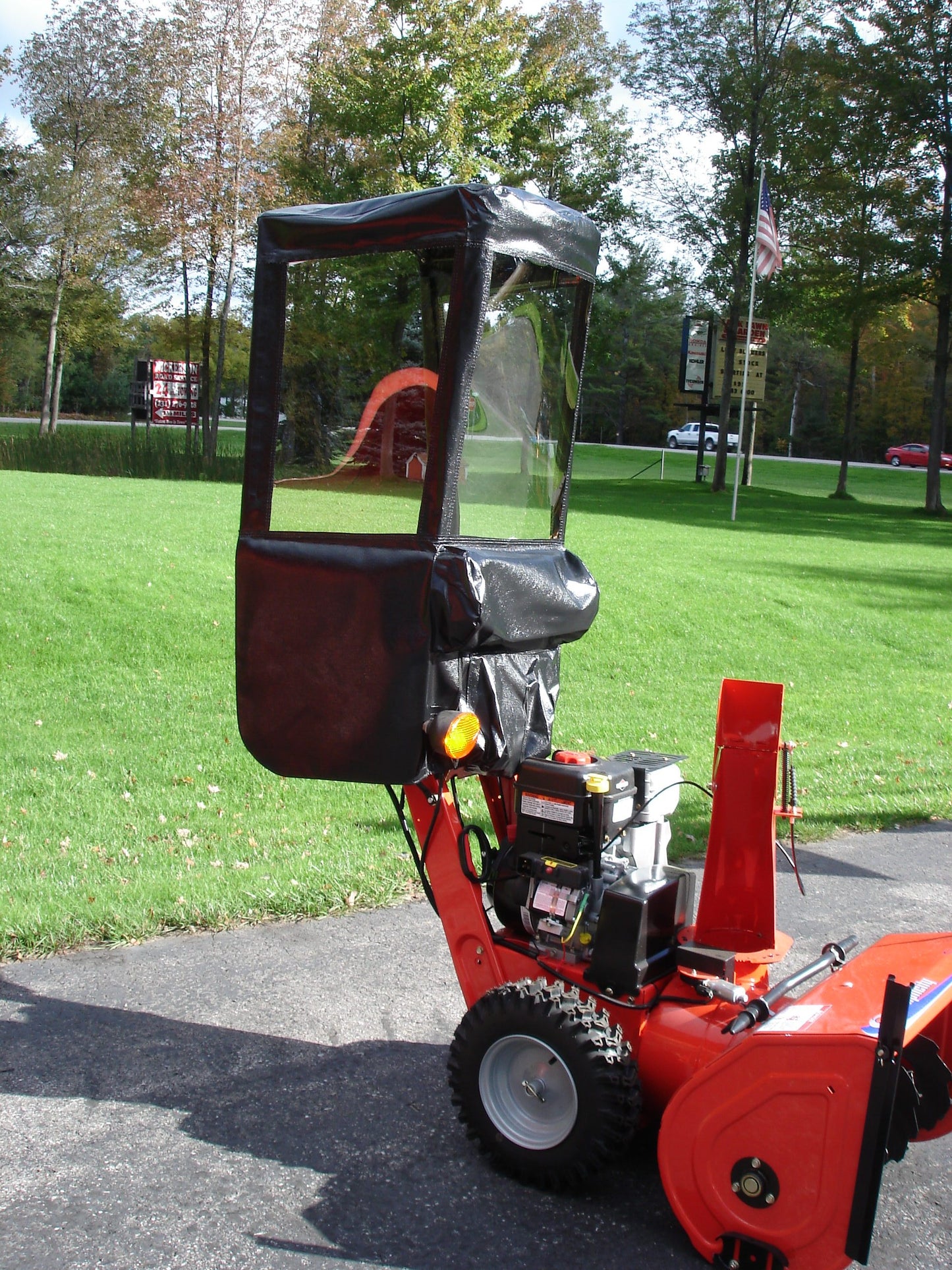
Simplicity Walk-Behind Snowblower Cab 9737
Take on winter with more weather protection from Original Tractor Cab. Snowblower Cab 9737 fits compatible Simplicity two-stage walk-behind snowblowers and helps shield the operator from blowing snow, swirling snow, sleet, and cold wind.
Snow removal can put you right in the path of winter weather. Therefore, this clear snowblower enclosure creates a useful barrier between you and much of the snow that blows back toward the handles.
Optically clear, shatter-resistant window material helps keep the work area in view. Meanwhile, nylon-reinforced ripstop vinyl forms the flexible enclosure around a strong 16-gauge, 1/2-inch steel tube frame.
Cab 9737 is made for Simplicity two-stage snowblowers. However, it will not fit units equipped with a light bar.
Original Tractor Cab 9737 for Simplicity Two-Stage Snowblowers
Winter storms rarely send snow in only one direction. Wind can catch loose snow and send it back toward your face, coat, and gloves.
Original Tractor Cab 9737 helps reduce that exposure. So, you can work behind a clear enclosure while you guide your Simplicity snowblower down a driveway or walk.
The cab is made for weather protection during normal snow removal.
Designed for Simplicity Walk-Behind Snowblowers
Original Tractor Cab lists model 9737 for compatible Simplicity two-stage walk-behind snowblowers.
Fit is based on the machine design, not just the Simplicity name. Therefore, check your exact model and configuration before you place an order.
This is very important on older equipment.
Important Light Bar Fit Warning
Original Tractor Cab states that Cab 9737 will not fit Simplicity units with a light bar.
So, inspect the handle and dash area before you buy. If your snowblower has a factory or added light bar, do not assume the cab will clear it.
Never remove safety equipment to force the cab to fit.
Check Your Snowblower Before Ordering
Simplicity has made many two-stage snowblower models over the years. Controls, handles, engines, lights, and other parts can vary.
For that reason, confirm the product identification number on your machine. Then, compare the unit with current Original Tractor Cab fit information.
A quick fit check can save time later.
Help Block Blowing and Swirling Snow
A snowblower can throw snow away from a drive or sidewalk. Yet wind can send fine snow right back toward the operator.
Cab 9737 places clear material in front of and around much of the operator area. As a result, it can help block snow that would otherwise strike the operator.
Actual coverage depends on wind and snow conditions.
Weather Protection for Long Snow Removal Jobs
A short sidewalk may take only a few minutes to clear. However, a long driveway or deep storm can keep you outside much longer.
As work time grows, direct exposure to blowing snow and cold wind can become less pleasant. Therefore, a snowblower enclosure can add useful comfort.
Always dress for the actual outdoor temperature.
Help Reduce Exposure to Sleet
Winter precipitation does not always fall as dry snow. Sleet and wet snow can also blow toward the operator.
The clear enclosure helps place a barrier between the operator and much of that weather. Still, Cab 9737 is not a sealed room.
Moisture can enter through openings and from behind.
Protection From Winter Wind
Cold wind can make a winter job feel much harder. In addition, the snowblower itself moves the operator through cold outdoor air.
Cab 9737 helps reduce some direct wind around the operating position. Thus, the enclosure adds another layer between you and harsh winter weather.
The cab does not contain a heater.
Optically Clear Window Material
Clear sight is vital when operating a snowblower. Therefore, Cab 9737 uses optically clear, shatter-resistant window material.
The clear panels help you see the driveway, sidewalk, chute area, and objects ahead. Meanwhile, the enclosure helps block some blowing snow.
Keep each clear panel clean before use.
Visibility Matters in Heavy Snow
Heavy snow can coat almost any outdoor surface. So, stop the machine if snow, ice, frost, or dirt blocks your view through the cab.
Clean the clear material with a soft method that is safe for flexible window material. Then, make sure your view is clear before you continue.
Never operate when visibility is poor.
Nylon-Reinforced Ripstop Vinyl
Original Tractor Cab uses nylon-reinforced ripstop vinyl in the Simplicity 9737 enclosure.
Ripstop construction helps the flexible material resist tearing during normal use. At the same time, vinyl lets the enclosure stay lighter than a rigid cab.
Inspect the material before each snow season.
Flexible Material for Winter Use
A walk-behind snowblower works in cold, wet, and windy conditions. Therefore, its cab must handle outdoor winter use.
The flexible material lets the enclosure form around the support frame. However, sharp tools, hot engine parts, and careless storage can still cause damage.
Keep the cab away from the exhaust.
16-Gauge Steel Tube Cab Frame
A 16-gauge, 1/2-inch steel tube frame supports Cab 9737. This frame gives the weather enclosure its shape around the operator.
Steel provides a firm support system for the flexible cab material. Still, the frame is not a certified operator protection structure.
Its job is to support the enclosure.
A Cab Frame Is Not a Safety Cage
The steel tubing may look strong. However, Cab 9737 does not provide certified impact, collision, rollover, or falling-object protection.
Likewise, it does not protect the operator from snowblower debris. Therefore, always follow all Simplicity safety instructions.
Keep factory guards in place.
Built for Two-Stage Snowblower Work
Simplicity two-stage snowblowers are made for demanding snow removal. Their auger gathers snow and feeds it toward an impeller.
Next, the impeller sends the snow through the discharge chute. This design can move deep and heavy snow more quickly than many small single-stage machines.
Cab 9737 helps protect the operator while that work takes place.
Why a Cab Helps on a Two-Stage Machine
A two-stage snowblower can throw a large stream of snow. Yet strong wind can change where loose snow travels.
Therefore, even a chute aimed away from you may not keep all snow away from the operator. A clear cab can help block some of that blowback.
Always watch wind direction as you work.
Keep the Snowblower Controls Clear
The operator must have full access to every control. So, inspect the cab after installation and make sure no material blocks a lever, trigger, switch, or control.
Test control movement with the engine off. Also, make sure you can safely enter and leave the normal operating position.
Correct any problem before starting the machine.
Do Not Modify the Snowblower to Force Fit
Older snowblowers may have replacement parts or owner-added accessories. Therefore, your machine may not match its original factory layout.
Never cut a factory guard, change a safety control, or remove needed equipment just to install Cab 9737.
Safe fit comes first.
Keep the Discharge Area in View
A snowblower can throw snow and hidden debris with great force. Therefore, the operator needs to know where the chute points at all times.
Cab 9737 must not block the normal view of the work area. If the clear material becomes covered with snow, stop and clean it.
Never direct discharge toward people or property.
Plan Your Snow Clearing Path
Wind direction can change the best way to clear a driveway. So, plan each pass to keep discharged snow moving away from cleared areas when possible.
This can also reduce the amount of snow that blows back against the cab. Therefore, a good clearing pattern may improve both visibility and comfort.
Adjust the plan as the wind changes.
Rain, Snow, Sleet, and Wind Protection
Cab 9737 is made to help with winter weather. The enclosure can help reduce direct exposure to blowing snow, sleet, and wind.
It may also block some rain that reaches the operator from the front and sides. However, the cab is not fully sealed or waterproof.
Weather can still enter around openings.
Cab 9737 Is Not Hail Protection
The flexible enclosure and clear panels are not certified hail protection. Therefore, do not remain outside during dangerous hail or severe weather because the cab is installed.
Move to safe shelter when severe conditions develop. Likewise, stop work when wind, ice, or visibility makes snow removal unsafe.
Safety always comes before finishing the job.
Cold-Weather Clothing Is Still Required
Cab 9737 can reduce direct wind and blowing snow. Yet it does not create a heated operator area.
So, wear boots, gloves, warm clothing, and other suitable winter gear. In addition, take breaks when cold conditions call for them.
Never rely on the cab alone for cold protection.
Snowblower Safety Comes First
A weather enclosure can improve comfort, but it cannot remove the hazards of a snowblower.
The auger and impeller can cause severe injury. Therefore, shut off the engine and follow the Simplicity operator manual before clearing a clog or working near moving parts.
Never place a hand inside the chute.
Watch for Hidden Objects
Snow can hide rocks, toys, sticks, newspapers, and other objects. A snowblower may pick them up and throw them.
For that reason, inspect the area before a storm when possible. Also, keep people and pets away from the work zone.
Cab 9737 is not a debris shield.
Care for Your Simplicity Snowblower Cab
Snow, road salt, dirt, and moisture can collect on winter equipment. Therefore, clean the enclosure as needed during the season.
Use mild cleaning methods on the clear window material. Then, allow the cab to dry before long-term storage.
Avoid harsh cleaners and rough brushes.
Inspect the Frame and Cab Material
Cleaning time gives you a good chance to inspect the cab. Look for loose hardware, bent supports, tears, or damaged clear material.
Next, check the mounting points and make sure the cab stays clear of hot engine parts. Repair problems before the next use.
Do not operate with damaged supports.
Store Cab 9737 With Care
Good storage can help protect a flexible snowblower enclosure. First, clean away dirt and salt.
Then, let the material dry fully. Avoid sharp folds in the clear panels, and do not place heavy objects on top of the stored cab.
Keep sharp tools away from the vinyl.
Why Buy Simplicity Cab 9737 Direct?
Buying direct from Original Tractor Cab connects you with the company that makes Cab 9737. That can be useful when you have a question about fit, installation, or replacement parts.
Browse more walk-behind snowblower cabs for other model-fit weather enclosures.
You can also explore our Simplicity cab and enclosure collection for compatible Simplicity equipment.
Before installation, review our installation manual library.
For help with fit or product questions, use the Original Tractor Cab contact page.
Simplicity Two-Stage Snowblower Specifications
Cab 9737 fits compatible Simplicity two-stage walk-behind snowblowers rather than one single machine. Therefore, one set of engine, width, weight, and drive specifications does not apply to every compatible snowblower.
Simplicity has offered many two-stage machines over the years. Engine size, clearing width, auger size, drive system, chute control, and other features can vary by model.
Use your product identification number for exact specifications.
How a Simplicity Two-Stage Snowblower Works
A two-stage snowblower uses two main steps to move snow. First, a steel auger gathers snow and moves it toward the center of the housing.
Then, an impeller takes that snow and sends it through the chute. As a result, the machine can handle deeper and heavier snow than many small single-stage designs.
The system also works well on many gravel drives.
Self-Propelled Drive
Simplicity explains that its two-stage snowblowers use a self-propelled transmission with forward and reverse speeds.
That drive helps move the machine instead of making the operator push its full weight through deep snow. Therefore, the operator can select a pace that suits the snow load.
Always use a safe walking speed.
Simplicity Snowblower Engine Design
Simplicity two-stage snowblowers use gasoline engines sized for winter work. Current Simplicity information highlights Briggs & Stratton Snow Series and Professional Series engines across its two-stage range.
However, older compatible machines may use a different engine or engine specification. So, always identify the engine installed on your snowblower before buying service parts.
Cab fit does not identify the engine.
Winter Engine Features
Snowblower engines work in low temperatures and demanding conditions. Modern Simplicity snow engines use designs aimed at winter starting and snow removal.
Electric start is also common on many models. Still, exact starting equipment varies by machine and year.
Follow the engine manual for cold starts.
Simplicity Clearing Width
Simplicity has offered two-stage snowblowers in several clearing widths. Published examples include 24, 26, 28, 30, 32, and 38-inch machines across different model ranges.
A wider housing can clear more snow in each pass. In contrast, a narrower machine can be easier to use in tight spaces.
Exact width depends on the model.
24-Inch Two-Stage Models
A 24-inch machine can offer two-stage snow power in a more compact package. This size can work well on sidewalks and smaller drives.
Still, the machine may use many of the same basic systems as a larger snowblower. Therefore, auger and impeller safety remains just as important.
Never work near moving parts.
28-Inch Two-Stage Models
A 28-inch clearing width provides a balance between coverage and machine size. Simplicity has used this width in both heavy-duty and professional-style product families.
Engine and drive details can differ between those models. So, use the exact product number when looking for parts.
Do not rely on width alone.
32-Inch and Larger Models
Large Simplicity snowblowers can cover a wide path on each pass. Published Simplicity product information includes 32-inch machines as well as professional-duty models with widths up to 38 inches.
These machines are made for large snow jobs. However, larger size also calls for added care around cars, buildings, and other objects.
Know your machine's full width.
Simplicity Auger and Impeller Design
Simplicity uses steel augers on its two-stage snowblowers. The auger breaks up and gathers snow before feeding it toward the impeller.
Then, the impeller moves the snow through the discharge chute. This two-step process gives the machine its two-stage name.
Both systems contain dangerous moving parts.
Never Clear a Clog by Hand
Packed snow can stop the chute or auger. However, stored energy may remain even after the controls are released.
Therefore, shut off the engine and follow the exact Simplicity manual before clearing any blockage. Use the approved clean-out method for your machine.
Never place a hand in the chute.
Simplicity Chute Controls
The discharge chute lets the operator control where snow goes. Depending on the model, Simplicity has offered dash-mounted, manual, and powered chute and deflector controls.
Current machines can also include quick-adjust or electric systems. Therefore, control layout varies greatly across the full two-stage family.
Cab 9737 must not block those controls.
Chute Direction and Cab Visibility
The operator should be able to see the snow discharge area through or around the cab. If the enclosure blocks a needed view, stop using the machine until the issue is corrected.
Likewise, keep snow and ice off the clear window. Good sight helps you control where discharged snow travels.
Never aim the chute at the cab.
Simplicity Dual-Trigger Steering
Many newer Simplicity two-stage snowblowers use dual-trigger steering. This system lets the operator stop power to either wheel to help turn the machine.
That can make a large snowblower easier to guide at the end of a pass. However, older machines may use another steering system.
Check the manual for your exact unit.
Simplicity Free Hand Control
Simplicity also uses Free Hand Control on many two-stage models. The feature can let the operator keep the traction drive engaged while freeing one hand for certain other controls.
Exact operation varies by model. Therefore, learn the system before working in deep snow.
Never defeat a control or interlock.
Heavy-Duty Simplicity Two-Stage Snowblowers
Simplicity has offered heavy-duty two-stage machines for deeper snow and larger properties. Published product information shows models with strong steel components, serrated augers, and large impellers.
These machines can move snow at a high rate. Yet the correct travel speed depends on snow depth and weight.
Slow down when the engine load rises.
Heavy-Duty Engine Examples
Published Simplicity specifications have included Briggs & Stratton 1150, 1450, 1650, and other Snow or Professional Series engines, depending on the machine.
Engine displacement and torque differ by model. Therefore, those numbers should never be applied to every snowblower that accepts Cab 9737.
Use the engine identification information.
Simplicity Signature and Signature Pro Snowblowers
Simplicity has also used the Signature and Signature Pro names for larger dual-stage machines.
Published Signature models have included clearing widths of 24, 28, and 32 inches. Meanwhile, Signature Pro machines have reached widths of up to 38 inches.
Exact cab fit must still be confirmed.
Professional-Duty Snowblower Features
Simplicity describes Signature Pro models as professional-duty machines. Published features include Briggs & Stratton Professional Series engines, integrated channel handles, and commercial-grade transmissions.
Those features help with demanding snow work. Still, Cab 9737 fit is a separate question from machine performance.
Check both before ordering.
Find Your Simplicity Snowblower Model Number
Simplicity states that the product identification label on a snowblower can be found near the base of the unit where the handlebars attach.
When standing behind the machine, look near the center or right side of that area. Then, record the complete model and serial information.
Those numbers help identify the correct manual and parts.
Why the Product Number Matters
Two Simplicity snowblowers can look very similar while using different parts. Therefore, the product number is one of the best ways to identify the exact machine.
Simplicity uses that number to locate operator manuals and illustrated parts lists. So, keep it with your equipment records.
Use it when asking about Cab 9737 fit as well.
Official Simplicity Snowblower Information
Machine specifications can vary by model and production year. Therefore, use official manufacturer information when you need exact service data.
For Simplicity snowblower information, operating guidance, and current product support, visit the official Simplicity snowblower guide.
For operator manuals and illustrated parts lists, use the official Simplicity manual search.
The History of Original Tractor Cab Company
Original Tractor Cab began in Indiana in 1939. The story started with farmer Stanley Williams and a simple need for better weather protection.
Stanley made a cab for his own farm tractor. Soon, other farmers saw the idea and wanted cabs for their tractors too.
One useful product became a business.
Stanley Williams Builds the First Cab
Farm tractors of that era left the operator open to rain, cold, wind, and snow. Stanley Williams knew those conditions from his own work.
So, he built a cab that could give him more weather protection. The design solved a real problem on his own farm.
Other farmers quickly saw its value.
A Farm Magazine Ad Starts Something Bigger
Stanley placed a small advertisement in a farming magazine. The response was strong enough to show that farmers in other places wanted the same type of product.
As a result, he started a company to make cabs for major farm tractor brands. Original Tractor Cab dates its beginning to 1939.
The company grew from a practical farm idea.
Original Tractor Cab During World War II
World War II changed the work of the young company. During the war, Original Tractor Cab made canvas items for the war effort.
That manufacturing work became another part of the company's history. Afterward, the business returned its focus to products for people who work outdoors.
The equipment market kept changing.
Robert Williams Develops the Walk-Behind Snowblower Cab
During the 1960s, Stanley's son Robert Williams saw another weather problem. People using walk-behind snowblowers faced cold wind and snow blowing back toward them.
Robert designed and patented a cab for walk-behind snowblowers. Therefore, Original Tractor Cab moved beyond traditional farm tractor cabs.
That idea directly connects with Cab 9737 today.
Snowblower Cabs Become Part of the Product Line
Walk-behind snowblowers gave homeowners a faster way to clear drives and sidewalks. Yet the operator still had to stand in winter weather.
Original Tractor Cab developed enclosures to help with that problem. As more snowblower brands and models appeared, the company created products for many specific machines.
The Simplicity 9737 cab follows that tradition.
Lawn and Garden Tractor Cabs Follow
Original Tractor Cab continued to expand after the snowblower cab. Lawn and garden tractor cabs soon became another part of the company's work.
That growth let the company serve more homeowners as well as farm operators. Thus, the product range grew with the outdoor power equipment market.
Model-fit products became a key part of the business.
Wayne Williams Adds the Sunshade
Cold weather created one type of operator problem. However, hot summer sun created another.
In the early 1990s, Robert's son and Stanley's grandson Wayne Williams designed and patented a sunshade for tractors and lawn and garden equipment. As a result, Original Tractor Cab could help outdoor operators in more seasons.
The company continued to evolve.
Three Generations of the Williams Family
Three generations of the Williams family helped build Original Tractor Cab. Stanley began the company, Robert expanded its product ideas, and Wayne added another important product category.
Each generation responded to a real outdoor need. Yet the main purpose stayed much the same.
Help make outdoor equipment work more comfortable.
Made in the USA Since 1939
Original Tractor Cab remains in Arlington, Indiana. The company has spent more than eight decades developing weather products for outdoor equipment.
Today, the line includes tractor cabs, mower enclosures, walk-behind snowblower cabs, zero-turn products, and sunshades.
Cab 9737 is part of that long manufacturing story.
From the First Tractor Cab to Simplicity Cab 9737
Outdoor equipment looks very different from the farm tractors of 1939. However, weather still creates many of the same problems for the person running the machine.
Snow still blows. Wind still cuts through winter clothing. Therefore, a clear snowblower enclosure still serves a simple and useful purpose.
Original Tractor Cab 9737 carries that idea forward.
Learn more on the Original Tractor Cab company history page.
Simplicity Snowblower Cab 9737 Frequently Asked Questions
What snowblowers fit Original Tractor Cab 9737?
Original Tractor Cab lists Cab 9737 for compatible Simplicity two-stage walk-behind snowblowers. Exact fit should be confirmed by machine model and configuration.
Will Cab 9737 fit a Simplicity snowblower with a light bar?
No. Original Tractor Cab specifically states that Cab 9737 will not fit units equipped with a light bar.
Is Cab 9737 made for single-stage snowblowers?
The current Original Tractor Cab product page identifies the 9737 as a cab for Simplicity two-stage snowblowers. Do not assume fit on a single-stage machine.
What is the clear window material?
Original Tractor Cab describes the cab as using optically clear, shatter-resistant window material.
What is the cab enclosure made from?
The flexible enclosure uses nylon-reinforced ripstop vinyl material.
What is the frame made from?
Original Tractor Cab lists 16-gauge, 1/2-inch steel tube construction for the 9737 cab frame.
Does Cab 9737 help block blowing snow?
Yes. The cab is designed to help protect the operator from blowing and swirling snow during normal snow removal.
Does the cab help with sleet?
Yes. Original Tractor Cab describes the product as helping protect the operator from blowing snow and sleet. However, the enclosure is not fully sealed.
Does Cab 9737 block wind?
The enclosure can help reduce direct winter wind around the operator. Still, cold air can enter because the cab is not a sealed or heated compartment.
Is Cab 9737 waterproof?
No. The enclosure can help block weather, but it should not be treated as a fully sealed waterproof structure.
Can I use Cab 9737 during hail?
The cab is not certified hail or impact protection. Stop work and seek safe shelter during dangerous hail or severe weather.
Does the steel frame provide impact protection?
No. The frame supports the weather enclosure. It is not a certified impact, collision, debris, rollover, or falling-object protective structure.
Does Cab 9737 protect me from thrown debris?
No. A snowblower may throw stones, ice, and other hidden objects. Cab 9737 is not a certified debris shield.
Where is the Simplicity snowblower model number?
Simplicity states that the product identification label is near the base of the machine where the handlebars attach. It is normally near the center or right side when standing behind the snowblower.
Why should I check the model number?
Simplicity has produced many two-stage snowblower configurations. The model number helps identify the correct operator manual, parts list, and machine specifications.
How does a two-stage Simplicity snowblower work?
The auger gathers snow and moves it toward the center of the housing. Then, an impeller sends the snow up and out through the discharge chute.
Are Simplicity two-stage snowblowers self-propelled?
Simplicity describes its two-stage snowblowers as using self-propelled transmissions with forward and reverse speeds. Exact drive features vary by model and year.
Is Cab 9737 a genuine Simplicity OEM product?
No. Cab 9737 is an aftermarket product manufactured by Original Tractor Cab Co., Inc. for compatible Simplicity snowblowers.
Non-OEM and Liability Disclaimer
This is an aftermarket product produced by the Original Tractor Cab Co. Inc., it is not a genuine OEM item. This product will only protect from elements not rollover or debris.
Original Tractor Cab Co., Inc. is not affiliated with, sponsored by, or endorsed by Simplicity or Briggs & Stratton. Simplicity, Briggs & Stratton, Snow Series, Professional Series, Signature, Signature Pro, Free Hand, related trademarks, logos, and model names remain the property of their respective owners. Brand and model references are used only to identify intended compatibility.
Cab 9737 is intended for compatible Simplicity two-stage walk-behind snowblowers. Original Tractor Cab states that the cab will not fit units with a light bar. The owner must confirm the exact model, configuration, controls, handle design, lights, accessories, and other installed equipment before purchase and installation.
Simplicity snowblower specifications vary by model and production year. Engines, clearing widths, transmissions, controls, chute systems, lights, and other equipment may differ. Therefore, use the exact product identification number and Simplicity manual for your machine.
Cab 9737 is designed to help protect the operator from blowing snow, swirling snow, sleet, wind, and similar weather. It does not create a sealed, heated, waterproof, impact-resistant, or certified protective operator compartment.
The steel cab frame is not a rollover structure, falling-object structure, collision guard, impact shield, or debris shield. The enclosure does not protect the operator from the auger, impeller, drive system, thrown objects, moving parts, or other snowblower hazards.
Always follow the Simplicity operator manual and current Original Tractor Cab installation instructions. Keep all factory guards, shields, controls, interlocks, warning labels, and other safety equipment in place and in proper working order.
Never place hands or feet near the auger, impeller, chute, belts, pulleys, or other moving parts. Shut off the engine and follow the Simplicity manual before clearing a blockage or servicing the machine.
Stop using the cab if it blocks visibility or interferes with a traction control, auger control, steering trigger, chute control, deflector control, engine control, operator movement, or any other machine function.
Never cut, drill, bend, remove, bypass, or alter factory safety equipment to force Cab 9737 to fit an incompatible snowblower.
California Proposition 65 Warning
WARNING: Cancer and Reproductive Harm — www.P65Warnings.ca.gov.
This product and the equipment on which it is installed may expose users to chemicals known to the State of California to cause cancer, birth defects, or other reproductive harm. Possible sources may include gasoline engine exhaust, fuel, oils, plastics, vinyl, metals, electrical parts, and other snowblower or accessory materials. Follow all product and equipment safety instructions. Use the snowblower outdoors with proper ventilation, wash hands after handling applicable materials, and avoid unnecessary exposure.